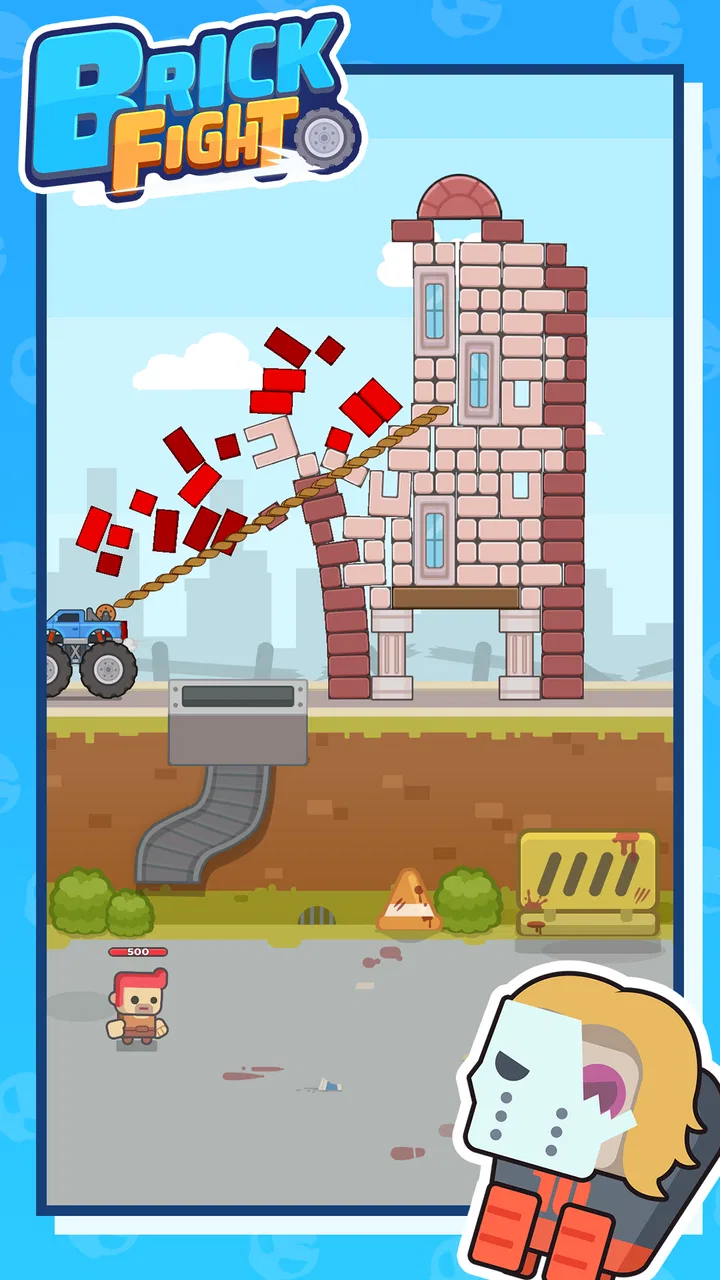
Brick Fight
- 4.2
- Rating
- 100.00K
- Installs
- Free
- Price

 Analysis by App-foxy
Brick Fight is an adventure game from VOODOO that takes a simple idea—fighting with bricks—and turns it into a compact, easy-to-start mobile experience. I found the appeal in its directness: there is no complicated setup to learn before getting into the action, and the short-session format makes it suitable for a quick break rather than a long evening of gaming. Its store summary, “The Art of Collapse,” hints at the destructive side of the experience, while the short description, “Brick Fight,” keeps the premise deliberately simple.
After spending time with it, my impression is that this is best approached as a casual action game with an adventure label, not as a deep role-playing adventure or a story-heavy journey. The fun comes from the immediate interaction and the satisfaction of handling a brick-based challenge, while the limitations come from that same narrow focus. If you want a game that starts quickly and asks for small bursts of attention, it is worth considering. If you need a large world, a detailed narrative, or a long-term progression system, you should set your expectations lower.
How the free model affects its value
Brick Fight is free to download and play, which gives it a low-risk entry point. You can try the core experience without paying upfront, a useful advantage for anyone who is unsure whether this style of action will hold their attention. The game includes optional in-app purchases ranging from $0.99 to $49.99 per item, so the free starting point should not be confused with an entirely purchase-free experience.
You May Also Like

 AccuWeather: Weather Radar
AccuWeather Review: A Quick, Clear Forecast for Everyday Decisions
For everyday plans, the best forecast is the one you can understand quickly. AccuWeather makes rain timing, radar, and local conditions easy to act on, with a few trade-offs.

 Hill Climb Racing
Why Hill Climb Racing Still Turns Crashes Into One More Run
A tiny car, a bumpy hill and one more upgrade: Hill Climb Racing keeps resurfacing because its simple chaos makes every near-miss feel personal.

 AliExpress - Shopping App
AliExpress Makes Global Shopping Feel Personal, but Shoppers Bear the Risk
AliExpress turns a global marketplace into a pocket-sized discovery engine. Its reach is useful, its shopping loop compelling, and its trade-offs easy to miss.

 Lords Mobile: Kingdom Wars
Lords Mobile Is a Kingdom-Building Routine, Not a Quick Match
A case-by-case verdict on the building, battles, device demands, and social commitments that make Lords Mobile rewarding for some players and exhausting for others.

 PDF Scanner app - TapScanner
TapScanner Makes Paperwork Easier to Capture, Check, and Share
TapScanner makes scanning with a phone feel less like a rescue operation and more like a dependable step in getting work done. Its capture tools are useful, though not flawless.

 Block Blast!
 Shows How Much a Puzzle Game Can Leave Out
A quiet grid game shows why puzzle players increasingly value instant clarity, repeatable skill and low-pressure play—and where the genre still needs to catch up.
More From Our News Desk
View All News


That price range matters because the value question depends on how comfortably you can enjoy the game without spending. I would not judge the title by its most expensive purchase. Instead, I would first play it as a free game and decide whether its basic loop is satisfying enough to justify any optional spending. A small purchase can feel reasonable when it improves convenience or supports a game I already enjoy, but it is harder to recommend spending heavily on a compact casual experience unless the player already knows exactly what they want from it.
The practical advantage of the free model is that Brick Fight works well as an impulse download. You do not need to commit money before learning whether the controls, pace, and repeated brick encounters suit you. The trade-off is that free games can make players more aware of interruptions, purchase prompts, or progression friction. I recommend treating every optional offer as something to evaluate rather than as part of the basic cost of entry.
Its audience size also suggests that it has found interest beyond a tiny group of experimenters: the game has passed 100K+ installs, with an average rating of 4.2 from around 1.4K ratings. Those figures do not guarantee that it will fit your taste, but they do make it easier to see the game as an established casual release rather than an obscure test project. The current version is 2.1.6, and it requires Android 8.0 or later, so compatibility is worth checking before installing on an older device.
What you are really paying for
In a game like this, paid value is not automatically measured by the number of levels or the size of the download. The more important question is whether the interaction remains enjoyable after the novelty of breaking or battling with bricks wears off. I found the strongest value in the immediate feedback: the concept is easy to understand, and the game does not require a long tutorial before you can decide whether you like it.
At the same time, I would be careful about spending early. Play enough free sessions to learn whether you enjoy the game’s rhythm, especially if you usually move quickly from one casual title to another. If the basic loop already feels repetitive before you have invested anything, a purchase is unlikely to solve that problem. If the game becomes a reliable way to relax for a few minutes, then a modest optional purchase may have personal value, but that is a decision based on your playing habits rather than a promise of extra depth.
How it feels in everyday play
The easiest way to understand Brick Fight is to imagine opening it while waiting for a bus or taking a short break between tasks. You want something more active than scrolling, but you do not want to remember a complicated storyline or spend time rebuilding your place in a large world. The game’s brick-focused action fits that situation because its premise can be understood immediately.
That convenience is one of its clearest strengths. I could approach it with a short-session mindset instead of planning a long play period. This makes it a good companion for players who enjoy mobile games in small portions. It also suits people who like tactile, destructive themes and straightforward challenges more than dialogue, exploration, or elaborate character customization.
My advice is to play with a clear stopping point. Casual action games can become less enjoyable when you continue after the central interaction has stopped feeling fresh. A useful routine is to play a few sessions, notice whether you are still making deliberate choices or merely repeating motions, and then decide whether the game deserves more of your time. That simple check helps separate genuine enjoyment from the habit of opening whichever game is already installed.
Three details that change the way I would play
First, I would use the opening sessions as a control test rather than rushing toward purchases. The important question is not only whether the brick theme looks entertaining, but whether the controls feel predictable enough that mistakes seem like my fault. That distinction matters in action games: a clear response encourages experimentation, while uncertain feedback can make even a simple encounter feel frustrating.
Second, I would treat the game as a short-session title even if a particular session becomes absorbing. The brick-fighting idea is strongest when it remains focused. Playing it between longer games, rather than demanding that it replace them, gives it a better chance to succeed. This is a useful trade-off: its narrow scope can feel refreshing during a break but limiting as the only game on your phone.
Third, I would delay judging its long-term value until the free experience has had time to settle. The first impression comes from the novelty of the theme, while the lasting impression comes from repetition. If you still enjoy the basic encounters after the initial surprise fades, the game has earned a place in your rotation. If not, uninstalling without spending is the sensible outcome.
Where it differs from familiar adventure alternatives
Compared with a traditional adventure game, Brick Fight is much more immediate and much less dependent on narrative investment. A conventional adventure title may reward you with exploration, characters, puzzles, or a larger sense of place. Brick Fight instead puts its identity in the physical idea of bricks and the directness of its action. That makes it easier to start, but it also means it may not satisfy players who play adventure games primarily for discovery and story.
Compared with an endless runner, it offers a different kind of attention. Endless runners usually focus on constant forward motion, timing, and avoiding obstacles. Brick Fight’s appeal is more closely tied to confronting a brick-based situation and enjoying the interaction itself. If you prefer reflexes and speed above everything else, an endless runner may feel cleaner. If you like the idea of action built around objects that can be struck, handled, or collapsed, this game has a more distinctive hook.
It also differs from a large free-to-play role-playing game. Those games often ask for regular daily commitment, extensive menus, collections, and long progression arcs. Brick Fight is easier to understand and less intimidating, but it does not offer the same sense of investment. I see that as a deliberate exchange rather than a flaw: it is better for a quick, focused diversion than for players seeking a second life inside a mobile world.
Limitations worth considering before installing
The biggest limitation is the risk of repetition. A focused concept can be memorable, but it can also reveal its boundaries quickly. If the core brick-fighting interaction does not keep changing in ways that matter to you, the game may lose its appeal sooner than a broader adventure title. I would especially caution players who need constant new environments, story developments, or systems to master.
The free-to-play structure is another point to watch. Because optional purchases reach from $0.99 to $49.99 per item, different players can have very different ideas of what the game costs in practice. The honest way to assess it is to separate access from extras: access is free, while spending is optional and should be judged against how often you actually return to the game.
The Teen content rating is also relevant for families. I would not present Brick Fight as a universal children’s game simply because its premise sounds playful. Parents should use the Teen rating as the appropriate guide for deciding whether it belongs on a younger player’s device, and they should also be aware that optional purchases can make supervision useful.
Device support may be a barrier for some people. Android 8.0 or later covers many phones, but not every older handset. If you are using an aging device, compatibility should be checked before you plan around the game. Even when installation is possible, action games are more enjoyable when the device responds reliably, so I would avoid judging the title solely on a phone that already struggles with modern apps.
Finally, the game is not the right choice for every kind of downtime. If you want a calm puzzle, a rich story, a cooperative experience, or a long-form adventure, the brick-fighting premise may feel too specialized. Choosing it because it is free will not change that mismatch. Its value depends on liking the central idea, not merely on wanting something to install.
Who is most likely to get value from it?
I would recommend Brick Fight first to casual players who enjoy quick action and unusual physical themes. It is also a sensible option for someone who wants to test a game without paying upfront. Since the game is from VOODOO and has built a noticeable audience, it is easy to add to a rotation of short mobile games without treating it as a major commitment.
It may work particularly well for players who enjoy the feeling of breaking through a simple obstacle or engaging with a compact challenge. The game’s identity is clearer than that of a generic adventure title because the brick idea is central rather than decorative. That gives it a specific audience: people who find the object-based action satisfying will probably appreciate its focus more than players who need a broad fantasy setting.
I would skip it if your main reason for downloading an adventure game is a strong story. I would also skip it if you dislike repeated action loops, prefer offline certainty, or become frustrated by optional purchase systems in free games. Those are not minor preferences here; they directly affect whether the experience feels convenient or restrictive.
For a teenager, the Teen rating should be part of the decision, not an afterthought. For an adult, the more important question is whether the game earns repeat sessions without requiring a purchase. I would give it a fair free trial, avoid spending during the first impression, and then decide based on whether I voluntarily return to it the next day.
My verdict on Brick Fight
Brick Fight is a focused, free adventure game that succeeds when you want quick brick-centered action and do not need a large amount of narrative or progression around it. I like its low barrier to entry and its clear identity. The game is easy to imagine using during a short break, and its free access makes experimentation sensible.
My recommendation is conditional rather than universal. Download it if the idea of brick-based fighting genuinely appeals to you and you are comfortable evaluating optional purchases carefully. Give it time to prove that the central loop has staying power before spending anything. The free model is its strongest value argument, while the narrow concept and potential repetition are the main reasons to keep expectations realistic.
With a 4.2 average and more than 100K+ installs, it has enough interest to justify a trial, but popularity should not replace personal fit. I would choose it over a heavier adventure game when I wanted something immediate and contained. I would choose a story-driven or exploration-focused alternative when I wanted depth, discovery, or a stronger sense of progression.
In short, Brick Fight is worth trying, not blindly buying into. Its best use is as a free, short-session action game with a distinctive brick theme. If that compact style matches how you play on mobile, it can deliver enjoyable value without an upfront cost. If you are looking for a complete adventure world, you will probably be happier elsewhere.
FAQs for Brick Fight
01What is Brick Fight, and how does it work?
Brick Fight is an engaging mobile game where players aim to break bricks by launching balls at them. The objective is to clear all bricks on the screen using strategic ball placements and power-ups. Its intuitive touch controls make it accessible for all ages, providing a fun and challenging experience.
02Is Brick Fight available for both Android and iOS?
Yes, Brick Fight is available for both Android and iOS platforms. Users can download it from the Google Play Store for Android devices and the Apple App Store for iOS devices. The game is regularly updated, ensuring compatibility with the latest operating systems.
03Are there any in-app purchases in Brick Fight?
Brick Fight offers in-app purchases that enhance the gaming experience. Players can buy additional power-ups, extra lives, and ad-free versions. While the game is free to download and play, these optional purchases can provide advantages and a more seamless gaming experience.
04Does Brick Fight require an internet connection to play?
Brick Fight can be played offline, making it perfect for users who want to play on the go without needing a constant internet connection. However, certain features like leaderboards and in-app purchases require internet access to function properly.
05What are the system requirements for Brick Fight?
For Android users, Brick Fight requires Android 5.0 or later, while iOS users need iOS 11.0 or later. The game is optimized for both smartphones and tablets, ensuring smooth gameplay across devices. Adequate storage space is also necessary for downloading updates and additional content.
Pros
- Intuitive controls make gameplay accessible.
- Colorful graphics enhance the gaming experience.
- Offline mode available for uninterrupted play.
- Frequent updates with new levels and features.
- Responsive customer support for troubleshooting.
Cons
- In-app purchases can be quite expensive.
- Ads can interrupt gameplay frequently.
- Requires a stable internet for some features.
- Limited customization options for characters.
- Game can become repetitive after frequent play.

Brick Fight
Gallery